
The club system / Finance and GST
FINANCE AND GST · FULL DETAILS
Everything about finance and GST
GST codes on every price, prices typed with or without GST, the BAS worksheet, bank reconciliation, income received in advance, this year against last, and a monthly summary for your accounts.
THE FULL WALKTHROUGH
Every part of Finance and GST, start to finish
A longer, slower walkthrough of Finance and GST is being made. Until it is here, the short demo shows each part working.
What it is
Finance and GST is the treasurer’s part of Sports Club OS. It reads the money the club already records (invoices, payments and till sales) and turns it into what the treasurer and the accountant need, without anyone typing it in twice.
It never changes the money. Payments are recorded where they always are, and Finance and GST works out the GST, matches the bank, and adds up the quarter.
Everything it does
- A GST code on everything
- Every price, membership fee, till product and invoice line is taxable, GST-free, input-taxed or not a sale. Each kind of income has its own default, and a membership type can have one code for its fee and another for its joining fee.
- Prices with or without GST
- The club chooses whether the office types prices including or excluding GST. Changing it can keep what members pay or add the GST to every price, and shows every amount before and after first.
- Tax invoices
- Invoices show the GST on each line and say which lines are GST-free or input-taxed. They are headed Tax invoice, Tax invoice / Receipt once paid, or Draft invoice. Existing invoices are never worked out again.
- GST on every payment
- Each payment records its share of the GST, so a fully paid invoice’s payments add up to its GST to the cent.
- The BAS worksheet
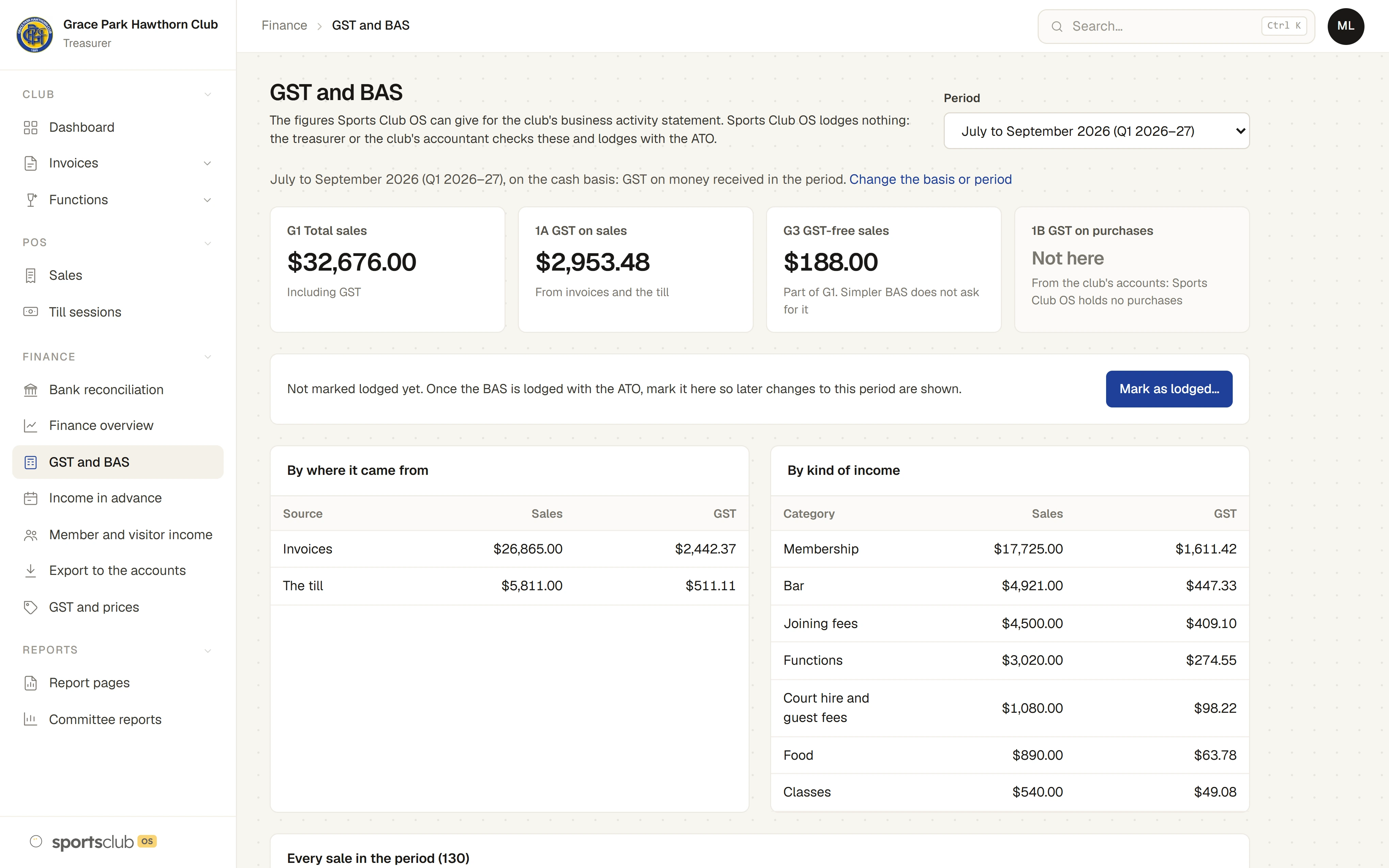
- Total sales (G1), GST-free sales (G3) and the GST on sales (1A) for a quarter or a month, by source and by category, with every sale behind them. Quarters are labelled the ATO’s way, such as “July to September 2026 (Q1 2026–27)”.
- Cash or accrual
- The club chooses its basis and how long a period is. A change takes effect from the start of the next period, so a period is never worked out two ways.
- Periods marked lodged
- Mark a period lodged once the BAS is done, and its figures are kept as they stood. Anything recorded later against it is listed on the next period’s worksheet, with the difference.
- The GST threshold
- The last twelve months’ sales against the $150,000 GST registration threshold for clubs.
- Bank reconciliation
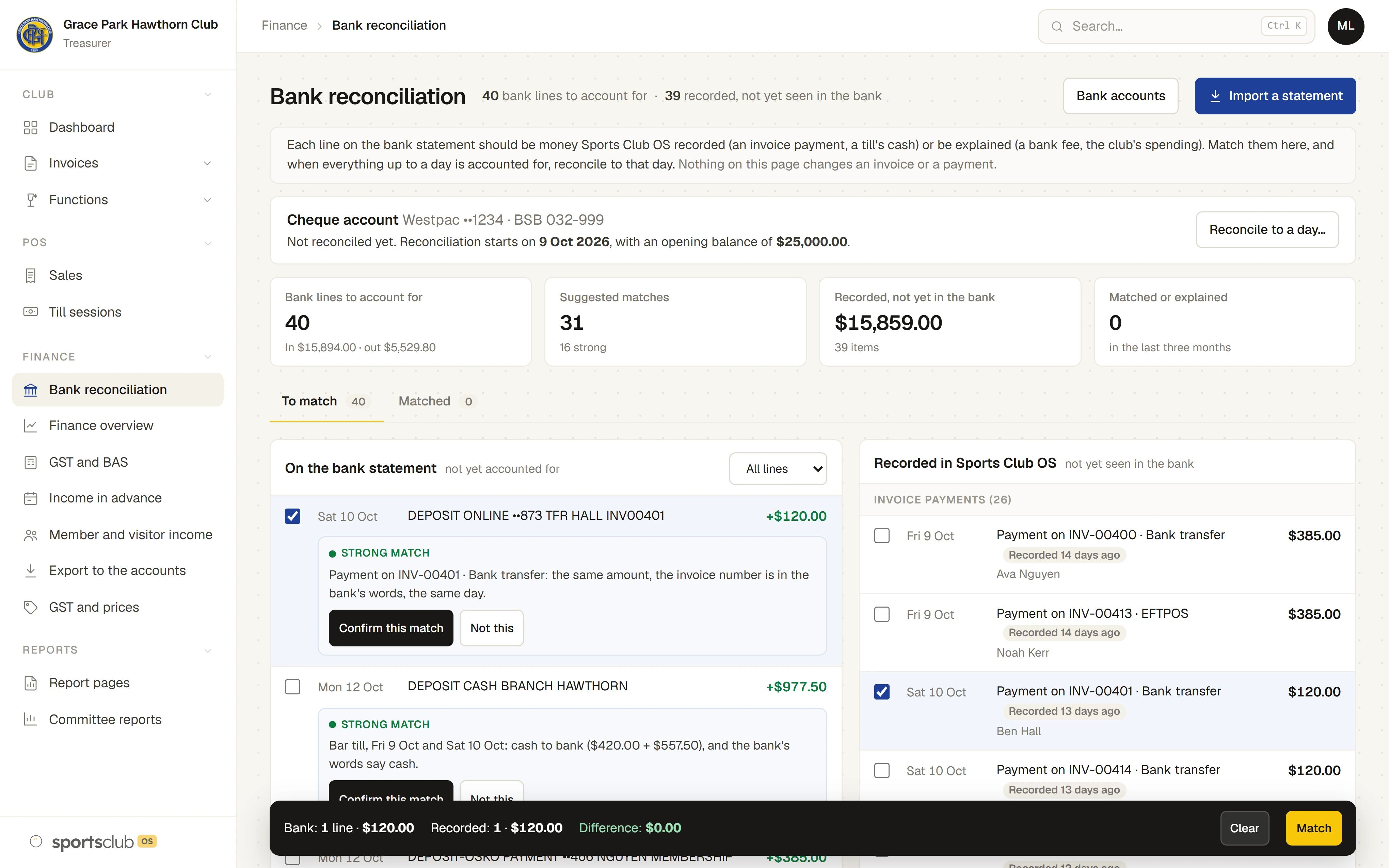
- Import the club’s bank statement as a CSV file and match each line to the invoice payments and till cash takings it paid for. Sports Club OS suggests matches, and nothing is matched until someone confirms it. One deposit can cover several payments, and several deposits can cover one payment. Lines with no payment behind them, such as a bank fee, are explained. Once the statement balances to a date, everything up to that date is locked.
- What reconciliation never touches
- It never changes a payment. The column layout is remembered for each bank account, the same line is never imported twice, the file itself is not kept, and only the BSB and the last four digits of an account number are kept.
- Income received in advance
- Membership fees are earned day by day over the time they cover, so on any date the treasurer sees how much of what has been received is not yet earned, by membership type and month by month. Joining fees can be earned when charged or spread over the membership.
- This year against last
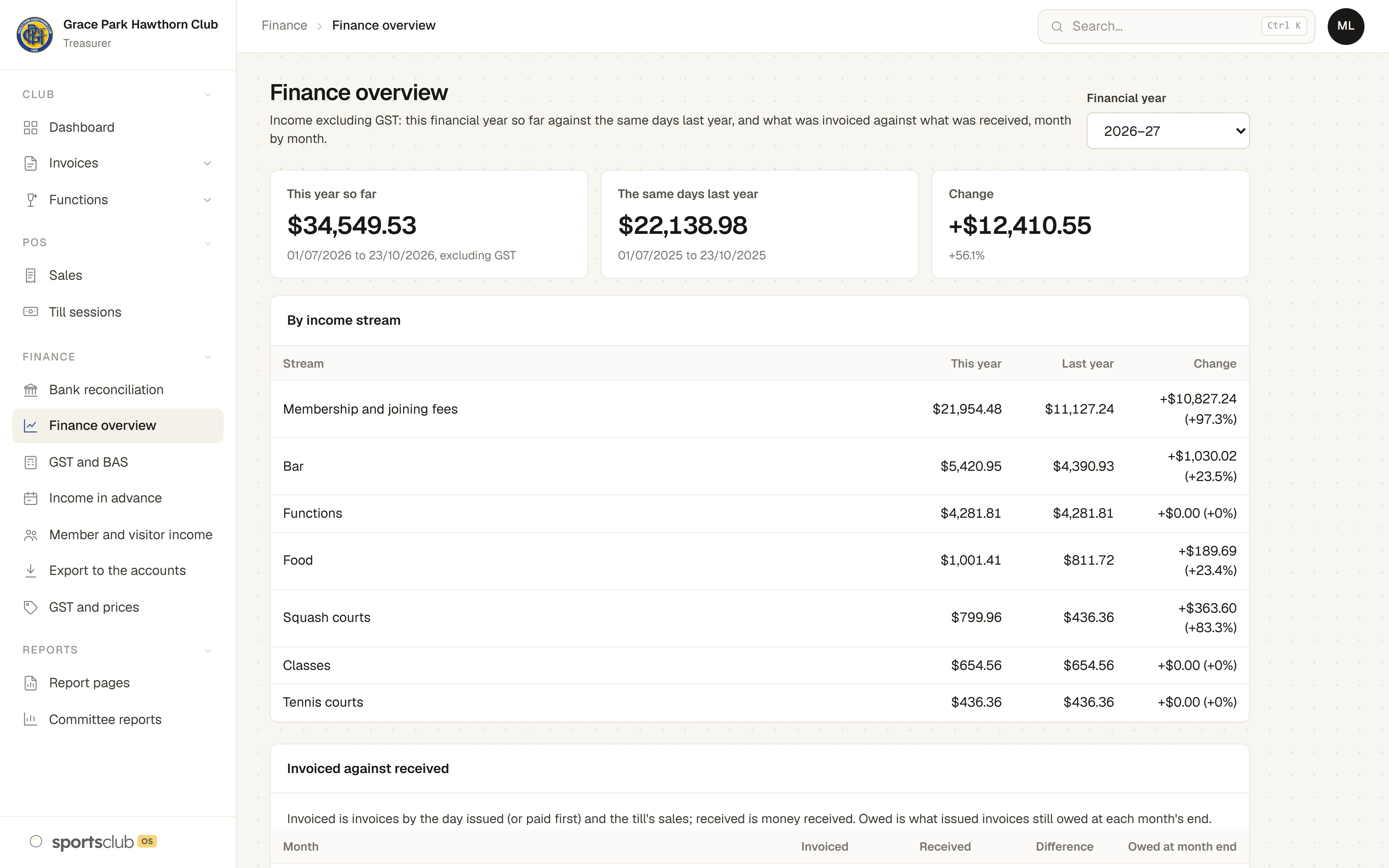
- Income without GST this financial year so far against the same days a year earlier, in total and by stream: membership, courts, classes, functions, the bar and more.
- Invoiced against received
- Each month’s amount invoiced against the money received, and what was still owed at the month’s end.
- Export to the accounts
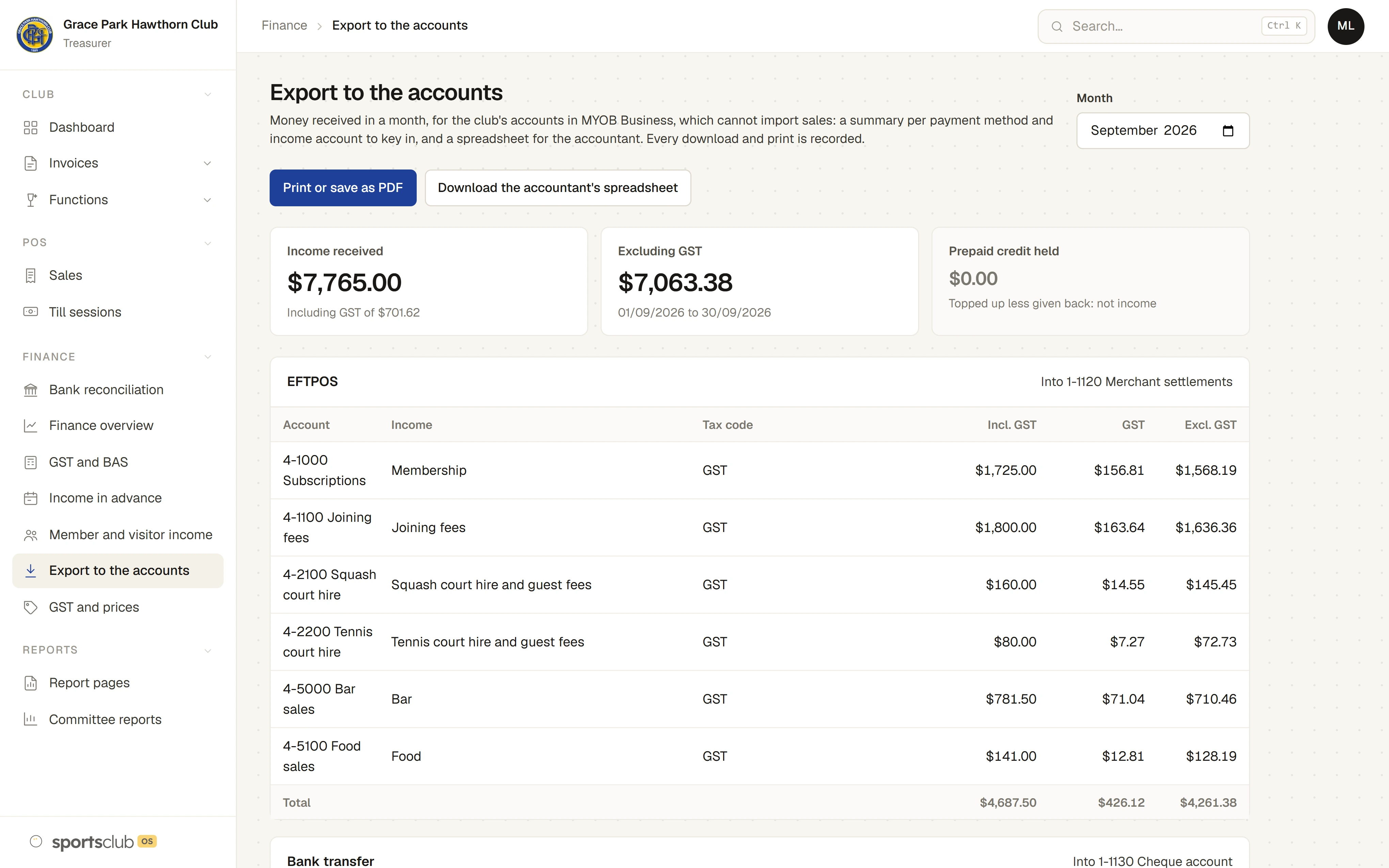
- Each month’s money as a summary to key into MYOB Business: for each payment method, income by the club’s own account and tax code, with and without GST, and prepaid bar credit kept apart. A spreadsheet for the accountant goes with it, a row per day, account, tax code and payment method.
- Your account codes
- Map each kind of income, court hire for each sport, and each payment method to the club’s own accounts once. Every month exported is recorded, and exporting a month again asks first.
- Member and visitor income
- Money received in a period split into income from members, guests, visitors and functions, each marked as the ATO classes it, with guest numbers from bookings and the till. Evidence for the accountant of a sporting club that is exempt from income tax.
How it works
- Set the GST codes once. Each kind of income has a default, and any price, fee or product can have its own.
- Money comes in. Payments are recorded against invoices and sold at the till as they always are, each with its share of GST.
- Reconcile the bank. Import the statement, confirm the suggested matches, explain the rest, and lock the period once it balances.
- At the end of the quarter. The BAS worksheet has the figures. Lodge as usual, then mark the period lodged.
- Each month. Export the month’s summary for MYOB and the accountant’s spreadsheet.
The screens
Real screens from Sports Club OS, on an invented club.
Settings and options
- GST codes
- The default code for each kind of income, and a code on any price, fee or product.
- Prices are entered
- Including or excluding GST, and what happens to stored prices when it changes.
- The BAS
- Cash or accrual, quarterly or monthly, and whether G1 includes GST, each from the start of a period.
- Joining fees
- Earned when charged, or spread over the membership they came with.
- Account codes
- The club’s income account for each kind of income and sport, a money account for each payment method, and the prepaid credit account.
- Bank accounts
- Each account’s name and bank, its BSB and last four digits, the date reconciliation starts from and the balance that day, and the column layout of its statement file.
Who can do what
| Who | What they can do |
|---|---|
| Treasurer | Everything in Finance and GST: GST codes, the BAS worksheet, income received in advance, the year’s figures, bank reconciliation and the export to the accounts. Also sees and manages invoices and payments, sees the sales figures and functions, and reads and downloads reports. |
| Administrator | The same. |
| Reporting | Sees imported bank statements and how they were matched. Not the rest of Finance and GST. |
| Everyone else | Nothing in Finance and GST. |
These are the starting roles. The club can change what each role may do on its Roles & permissions page, give a person several roles, and take a role away when they step down. The server checks every request against those roles, so a hidden button is never the only protection.
What gets sent
| To | What |
|---|---|
| Nobody | Finance and GST sends no emails. Nothing is lodged with the ATO or sent to your accounting software: the BAS worksheet and the exports are for you to use. |
Questions
Does it lodge our BAS?
No. The BAS worksheet gives the figures for your BAS, and you lodge it as you do now. Marking the period lodged keeps its figures as they stood.
Does it do GST on our purchases?
No. The club’s bills are not in Sports Club OS, so the GST you paid (1B) comes from your accounts.
Can we type prices without GST?
Yes. Choose “excluding GST” and every price field shows and takes amounts without it. Stored prices stay exact either way.
Does it connect to Xero or MYOB?
Not directly. MYOB Business does not import sales, so each month exports as a summary to key in, with a spreadsheet for your accountant. A Xero connection is being built.
Can we reconcile our bank statement?
Yes. Import it as a CSV file, check the suggested matches against invoice payments and till cash takings, and confirm them. EFTPOS settlement days with their fees, OFX files and an export for Xero are not built yet.
Are our old invoices changed?
No. Invoices raised before GST codes keep the GST they had. Older payments’ GST is worked out as one eleventh where it was not recorded, and the worksheet says where it has done that.
We are an income-tax-exempt sporting club. Does that matter?
Member and visitor income splits what members, guests, visitors and functions paid, so your accountant has the figures. It does not decide your club’s tax position.
On its way
A Xero connection.
For bank reconciliation: EFTPOS settlement days with their fees, OFX files, a summary page for the committee pack and an export for Xero.
Works with
 Membership Management
 Point of Sale
 AI Reporting
BOOK A WALKTHROUGH
Get a personalised walkthrough and demo
Book a walkthrough and bring the jobs that take your office the longest.