
Articles / Club event planning: a step-by-step guide for Australian sports clubs
ARTICLES FOR SPORTS CLUBS
Club event planning: a step-by-step guide for Australian sports clubs
A good club event comes down to five decisions made early: why you are holding it, who runs it, what it will cost, what approvals it needs, and how you will judge it afterwards. Get those right and the rest is logistics. Sports Club OS puts event and function scheduling, bookings, bulk communications, rostering and financial reporting in one place, so the committee is not chasing details across spreadsheets and inboxes.
Published 14 November 2026.
The event planning process at a glance
This guide walks a committee through the whole process, using planning guides written for Australian clubs by sporting bodies, universities and governments.
Most Australian guidance follows the same arc. The AFL's ClubHelp guidance on club events runs from defining why the event is being held, through deciding who organises it, to an early budget and workplan, a marketing and communications plan, delivery, and evaluation. Monash University's guidelines for affiliated sport clubs compress this into three stages: pre-event planning, delivery (including setup and pack-down) and evaluation with a stakeholder debrief.
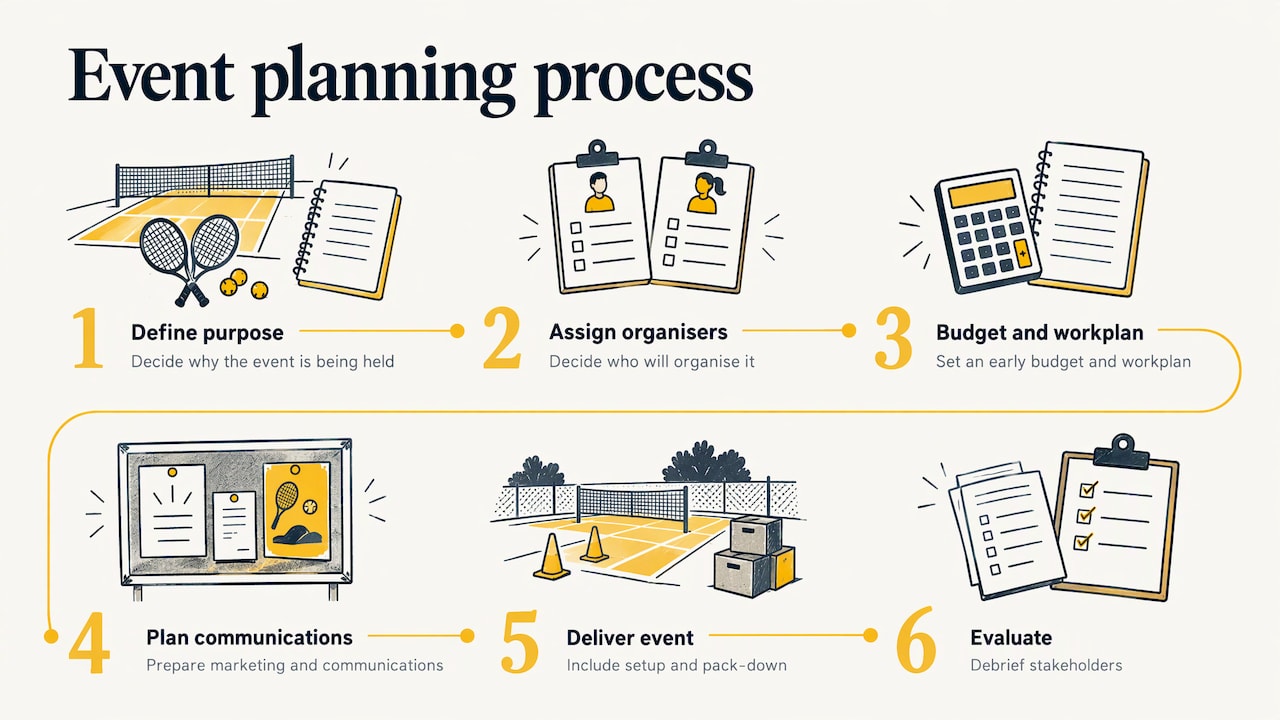
The sections below follow that order, with the traps committees most often meet at each step.
Step 1: Decide why you are holding the event
Write the purpose in one sentence before anything else. A season launch to welcome new members, a fundraiser for new lighting, a junior come-and-try day and a presentation night all need different venues, budgets and promotion. The purpose also gives you the measure you will use at the end: money raised, new members signed, attendance, or member satisfaction.
Then add the basics the NSW Government's pre-planning resource asks for: when and where the event will be held, what people and money are available, who is responsible for running it and who else needs to support it. Monash adds the event type, the activities, the audience and an estimated attendance.
Where it goes wrong: committees skip the attendance estimate. Every later decision (venue size, catering, number of volunteers, ticket price) depends on it. Use last year's attendance at a comparable event, your membership numbers and your RSVP trend, then plan for a range rather than one figure.
Step 2: Choose the date, format and venue
Check your date against the club calendar, your sport's competition fixtures and other local events before you tell anyone. Monash's guidelines suggest asking each venue about availability, capacity for different event formats, what the package includes and what it costs, then choosing within budget and paying a deposit to lock it in.
If your own clubhouse or courts are the venue, the same discipline applies internally: a function can clash with social competition, coaching or a hire booking. Clubs that keep facility bookings and function scheduling in one system see those clashes before they happen. That is what function room and venue hire software and court booking software for clubs from Sports Club OS are built for.
A quick venue comparison sheet keeps the decision fair:
| Question to ask | Why it matters |
|---|---|
| Is the date free, and is it held with a deposit? | Early planning improves your odds of the preferred date |
| What capacity suits a seated, standing or activity format? | Capacity differs by format |
| What is included in the package? | Tables, sound, cleaning and staff are often extras |
| Is access suitable for people with disability? | Access needs belong in the plan, not the afterthought |
| What does the total cost come to? | Compare against your budget, not the headline hire fee |
Step 3: Build the budget before you promote
A budget set early lets you price tickets sensibly and decide whether the event is viable. The AFL guide says to list expenses first (venue and equipment hire, food and drinks, decorations, promotion, trophies, permits and insurance) and then identify income such as grants, sponsorship, tickets, sales, raffles or merchandise.
The NSW Government's event planning and delivery resource gives a longer prompt list for sporting events: venue hire, staffing, equipment, officials, audiovisual, signage, uniforms, medical services, promotion, websites, photography or livestreaming, prizes, functions and security. Run your event against it and see what you forgot.
Three habits make the budget useful:
- Include a contingency. Surf Life Saving NSW's club guide suggests allowing 10%, and using previous accounts where you have them.
- Count free and subsidised items. The same guide says to list them too. It records the true resource requirement, so you are not caught out if a donation falls through.
- Allow for GST. Alice Springs' event planning guide says GST is 10% on most goods and services sold or consumed in Australia, and recommends separate line items with estimated and actual costs.
Also set a cut-off date. If ticket sales or sponsorship are not on track by then, Surf Life Saving NSW advises deciding whether to scale back rather than carrying the shortfall. Having a clear budget early also helps if you apply for a grant: Australian Cycling's organiser guide notes that early cost and revenue estimates support funding applications and acquittals.
Tracking spend and takings: a spreadsheet works for one event, but it becomes hard once a function runs across a bar, a raffle and ticket sales. Sports Club OS includes financial reporting and point of sale, so management teams can see consolidated results in one report rather than reconciling separate sources.
Step 4: Assign roles and build the workplan
Events fail when everyone assumes someone else has the catering. The AFL guide recommends a workplan that lists every job, its owner, its completion date and updates, reviewed after each meeting and used to report progress to the committee. For larger events it suggests a chaired subcommittee with clear responsibilities for activities, venue and logistics, food and drinks, budget and finance, marketing, and volunteers.
Monash suggests naming one event manager, then roles such as event coordinator, venue, marketing and ticketing, catering and transport, each with specific instructions, deadlines and regular meetings. Surf Life Saving NSW's list of event tasks is a handy prompt for the less obvious jobs: setup and pack-up, transport, results, medical and safety, security, accreditation, PA and publicity.
Volunteers
Recruit through the channels your members actually read. Alice Springs' guide lists social media, radio and email, and recommends recognising helpers with event tickets, merchandise or meals. It also says events using volunteers need certificates of currency for personal accident and public liability insurance, so ask your insurer early.
If your event involves paid or rostered staff as well as volunteers, staff rostering and function sheets can be printed from templates, and the staff and managers page shows how Sports Club OS handles rostering day to day.
Catering
Monash recommends asking for sample menus and quotes from more than one caterer. Check vegetarian, religious and allergy needs, and ask for ingredient information so guests can make informed choices.
Step 5: Sort approvals, safety and insurance
Requirements depend on your state, venue, activity and scale, so the rule is: ask early, and ask the right bodies. Contact the council, your sport's governing body and the facility owner. Then prepare a risk management plan, emergency and weather contingencies, first aid and insurance, and check any liquor, food, traffic, noise or public-land approvals.
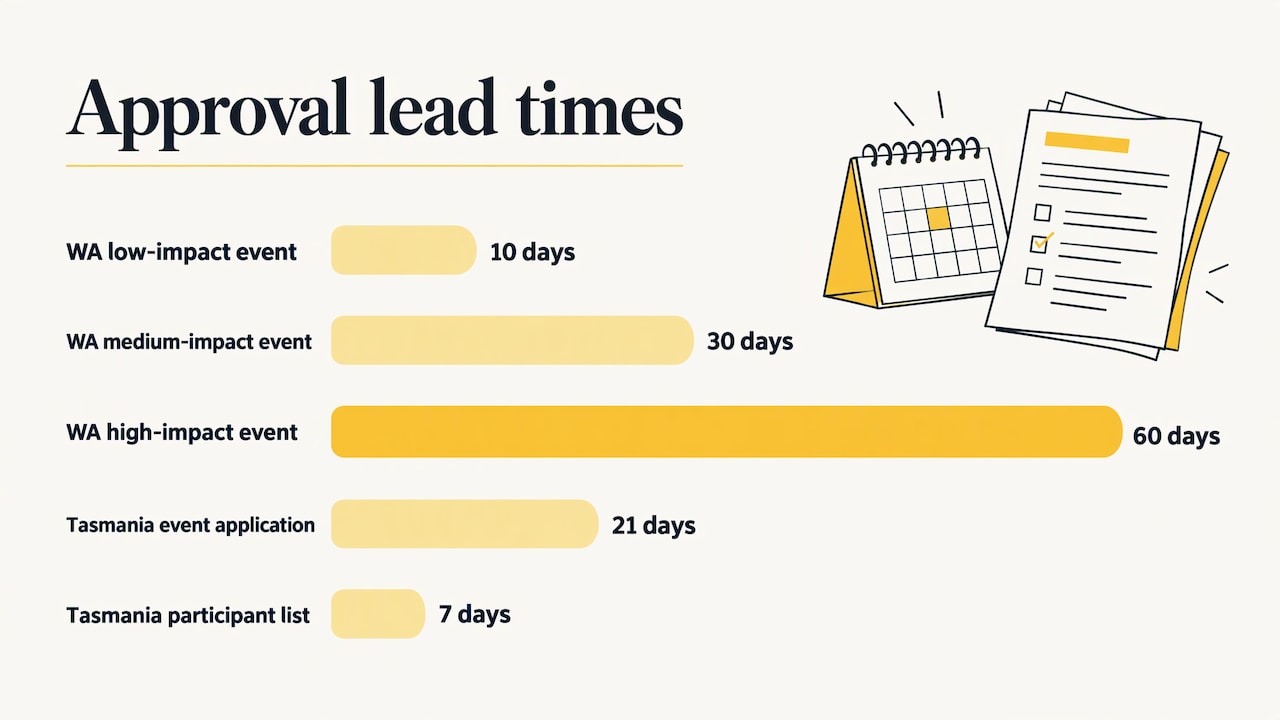
The lead times in current Australian documents show why early matters:
- Local council, Western Australia: the City of Rockingham's 2024 outdoor event guidelines set minimum lodgement periods of 10, 30 and 60 days for low-, medium- and high-impact events. Registered clubs' seasonal use of sports fields is exempt, but a club event at another location needs an application. Medium-impact applications need a site plan and public liability cover of at least $10 million.
- Sport body, Tasmania: Football Tasmania's sanctioning policy requires an application at least 21 days before a non-standard football event, with a participant list including Working With Children Checks due at least seven days before.
- University clubs, Queensland: the UQ Sport affiliated clubs handbook, updated December 2025, requires risk documents for one-off events two weeks beforehand.
These are examples, not your rules. Check your own council and association, and treat the risk management plan as a living document. Alice Springs' guide says it should cover setup, delivery and bump-out, be shared with stakeholders, and identify hazards early so controls can be put in place.
For anything involving alcohol, children, road closures or public land, speak to your council and state regulator, and to your insurer about cover, before you advertise.
Step 6: Promote the event to members
Tell people when, where and what, in the channels your audience uses. Monash lists newsletters, flyers and posters, email, word of mouth, social media and local press. For a membership club, your own members are the main audience, so the quickest wins are usually direct: an email to everyone, a notice at the clubhouse and a post on the club website.
With Sports Club OS, bulk communications, the member inbox and the AI-powered website editor sit alongside the membership list, so the same event can be announced to the right groups and the club site updated without a separate set of tools.
Two habits lift turnout:
- Send more than one message. An initial announcement, a reminder when tickets or places are limited, and a final logistics note with parking, start time and what to bring.
- State access and dietary information up front. Monash says disability access and dietary needs belong in planning and catering. Saying so in the invitation lets people book with confidence.
If you are tracking who turned up against who said yes, our guide to event attendance tracking covers the practical side.
Step 7: Run the day from a run sheet
On the day, follow the plan you wrote. Alice Springs' guide says a run sheet should hold team and contractor contact details and a timetable covering bump-in, opening, awards, performances and bump-out. Print it, give every lead a copy and name one person who can make decisions on the spot.
A short on-the-day checklist:
- Confirm contractors and volunteers have arrived and know their roles.
- Walk the site against the risk management plan, including first aid points and emergency exits.
- Check the weather plan and agree who calls it.
- Record attendance, takings and any incidents as they happen, not from memory.
- Allow time at the end for pack-down and a proper clean-up.
Surf Life Saving NSW notes that safety and rescue plans and weather contingencies are integral to planning, not extras added on the day.
Step 8: Debrief and carry the lessons forward
The AFL guide's evaluation steps are simple: review spending against forecasts, debrief stakeholders, survey attendees and write a post-event review with recommendations. It also suggests beginning to think about the next event while evaluating.
Surf Life Saving NSW recommends holding the debrief within two weeks, then thanking helpers, paying accounts, sending results and media information, balancing the accounts and reporting to sponsors and stakeholders. That ties learning to financial close-out and volunteer recognition, which is what makes people volunteer again.
Compare results against the purpose you wrote in Step 1. An event-training guide for councils also suggests a SWOT review and an updated event manual so the next committee does not start from zero. That handover problem is why we built a committee handover pack.
Our view: events should not depend on one person's memory
Every club we know has the same story. One enthusiastic volunteer runs the annual dinner brilliantly, then steps down, and the spreadsheets, supplier contacts and lessons leave with them.
We think event planning gets easier when the club's core information lives in one place: members, bookings, function schedules, rosters, communications and finances. The workplan, budget and debrief described above are sound practice on any system. They work better when the membership list, the facility calendar and the money are connected, because the committee sees the same picture.
Sports Club OS was built by people with direct club management experience, and our design choices come from club feedback. We want a new committee to open the system next season and find the history already there.
Adam
How Sports Club OS supports club events
Sports Club OS is a cloud-based, AI-powered operating system for sports clubs. For events, it brings together event and function scheduling, facility and court booking, staff rostering, financial reporting, point of sale, bulk communications, a member inbox and an AI-powered website editor. It is fully managed, with no installation, and pricing is a fixed monthly fee with no hidden fees or revenue share.
Committees can see how it fits their club on the committees page, or look at the full sports club management software to see how the pieces connect.
If you are weighing up options, our guide on how to choose club management software sets out the questions to ask, and you can book a walkthrough from the Sports Club OS site.
Sources
- AFL ClubHelp: club events
- NSW Government: Before you start planning your event
- NSW Government: Event planning and delivery
- Monash University: Affiliated sport club event management guidelines
- Alice Springs Town Council: Event Planning Guide
- Surf Life Saving NSW: Club Guide 4.5
- Australian Cycling: Event Organisers Guide
- City of Rockingham: Outdoor Event Guidelines 2024
- Football Tasmania: Event and Tournament Sanctioning Policy
- UQ Sport Affiliated Clubs Handbook
- Planning and Running Sporting Events
How far ahead should a club start planning an event?
As early as you can. Monash's guidelines say early planning improves the chance of securing preferred dates, venues and speakers, and leaves more room for unexpected changes. If approvals are involved, council and sport body lead times of 10 to 60 days or more can apply, so check them before you set the date.
What should a club event budget include?
List every expense, including venue and equipment hire, food and drinks, promotion, trophies, permits, insurance and GST, then your expected income from tickets, sponsors, grants and sales. Add a contingency of around 10%, as Surf Life Saving NSW suggests, and record free or subsidised items too.
Who should run a club event?
Name one event manager, and for larger events set up a chaired subcommittee. Give each person a specific role, such as venue, catering, marketing or volunteers, with a due date in a shared workplan that the committee reviews at every meeting.
What happens after the event?
Hold a debrief, ideally within two weeks. Review actual spending against the budget, survey attendees, thank volunteers, pay outstanding accounts and write a short review with recommendations, so the next event starts from what you learned.
BOOK A WALKTHROUGH
Get a personalised walkthrough and demo
Book a walkthrough and bring the jobs that take your office the longest.