
How it works
Ladders, boxes, round robins and knockouts
The four kinds of competition, how each is made and moves, its rules and their defaults, and the scoring each sport can use.
Who this is for: Anyone with “Run competitions” or “Play in competitions” (by default: Administrator, Sports Convener, Member).
Every competition is one of four kinds, in one sport (squash, tennis, padel, pickleball, badminton or snooker), singles or doubles. Padel is doubles only and snooker singles only. The kind decides how the competition is made when entries close, how a result moves it, and what its board shows. The usual rules are filled in when the convener creates it, and can be changed until it starts. Each competition's Rules tab says its rules in words.
Ladder
A standing list that never ends. Players join and leave as they like.
- When the ladder opens, it is ordered by club rating. Anyone who joins later starts at the bottom.
- You challenge someone a few places above you. They answer, then the two of you play.
- If the challenger wins, they take the place and everyone between moves down one, or (if the convener chose it) the two swap places.
- Turning a challenge down gives the challenger the place.
- One challenge at a time each.
- The Ladder tab shows each place, each player's club rating, who has moved in the last four weeks, and the open challenges.
| Rule | Usual |
|---|---|
| Challenge up to this many places above | 3 |
| If the challenger wins | They take the place; the rest move down |
| Days to answer a challenge | 5 |
| Days to play it | 14 |
| Drop a place after this many days without playing | 42 |
Box league
Small groups of a similar standard. Everyone in a box plays everyone else in it over a round of a few weeks.
- When entries close, the boxes are made from the club ratings, strongest in Box 1.
- A box's table reads across: the row's score against each column. Points come for playing, for each game won, and for winning.
- At the end of a round the convener presses Close round (then Press again: this moves people). The top of each box go up, the bottom go down, and the next round opens. A match not played by then scores nothing.
- A player can Sit out next round, and comes back in at the bottom.
- Someone added during the season joins the bottom box next round.
| Rule | Usual |
|---|---|
| Players in a box | 5 |
| Weeks in a round | 4 |
| Go up from each box | 1 |
| Go down from each box | 1 |
| Points for playing | 1 |
| Points for each game won | 1 |
| Extra points for winning | 2 |
Round robin
Everyone plays everyone, once or twice, a round at a time, with a table of points. It finishes when every match has a result, and the top of the table wins. Level on points, whoever won when the two met is ahead, then games (or sets) for and against.
| Rule | Usual |
|---|---|
| Everyone plays everyone | Once |
| Days for each round | 7 |
| Points for a win | 3 |
| Points for each game won | 0 |
Knockout tournament
A seeded draw: win and you go through, lose and you are out.
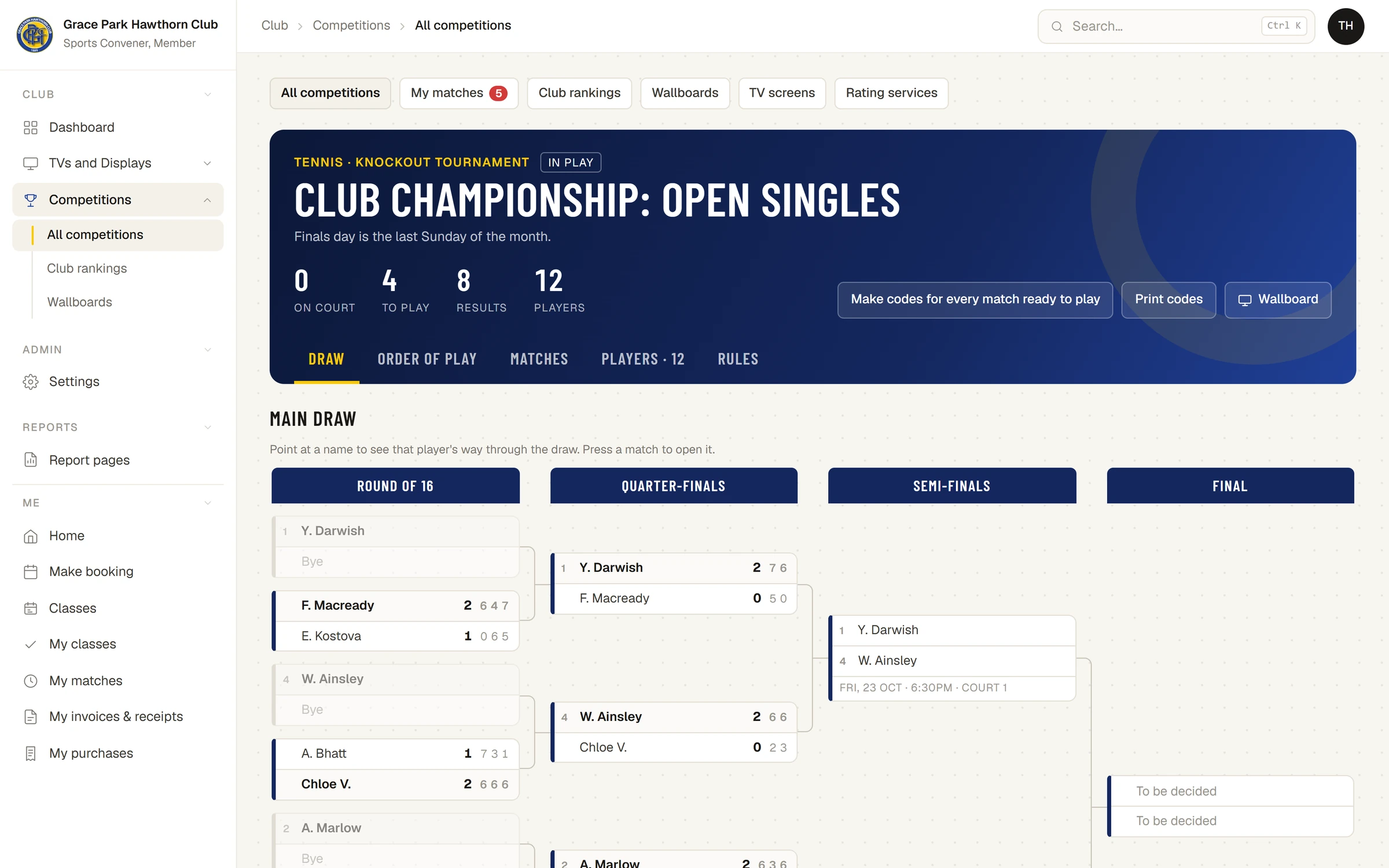
- When entries close, the top players by club rating are seeded and kept apart, and the rest are drawn at random. Byes go to the top seeds.
- With a plate, players who lose their first match go into a second draw.
- The Draw tab shows each round. Point at a name to see that player's way through the draw. A match in play shows its score as it is played, and a box flashes gold when its score changes.
- A result in a knockout can be corrected to change who won only until the match it led to has been played.
| Rule | Usual |
|---|---|
| Seeded players | Top 4 (or none, top 2, top 8, or everyone in rating order) |
| A plate for first-match losers | Yes |
Scoring
The convener chooses how a match is scored when creating the competition. It cannot change once the competition has started.
| Sport | Choices with the rulebook alone |
|---|---|
| Squash | Best of 5 or 3 games to 11 |
| Tennis | Best of 3 or 5 tie-break sets |
| Padel | Best of 3 tie-break sets; two sets, then a match tie-break to 10; short sets to 4 |
| Pickleball | Side-out scoring: one game to 11, the best of 3 or 5 games to 11, or one game to 15 or 21 |
| Badminton | Best of 3 games to 21 (3x21), or to 15 (3x15) |
| Snooker | Best of 3 or 5 frames |
Where the club offers them on , Scoring, more are listed: for squash, games to 15 and hand-out scoring to 9; for tennis, a match tie-break, no-ad, Fast4, pro sets, short sets and Tie Break Tens; for padel, golden point and Padel Australia's shorter formats; for pickleball, rally scoring and games to 7 or 25; for badminton, one game to 21 or 25 and the best of 5 games to 11. A competition copies the rules when it is made: see Choose the club's scoring rules.
- Each sport's rules follow its current rulebook unless the club offers other rules and the competition uses them: the World Squash Singles Rules 2025, the ITF Rules of Tennis 2026, the FIP Rules of Padel 2026 (Star Point), the USA Pickleball Official Rulebook 2026 and the BWF Laws of Badminton (3x21 until 3 January 2027, 3x15 from 4 January 2027).
- At 10-all (14-all playing to 15), squash point-a-rally games are won by Always two clear points (the current rules). Where the club offers them, a competition can choose The players choose: two clear points, or next point wins, or Always next point wins. A competition made before keeps the choice it had.
- Between games the scorer's break is two minutes in squash, or 90 seconds in a squash competition that says so. Tennis and padel have two minutes between sets and 90 seconds at a change of ends; pickleball and badminton have two minutes between games, with time-outs and intervals as their rules say.
- A retirement in squash, tennis, padel and badminton keeps the score as played, with how it ended; where the competition awards the remaining points (a club option), the other side is given every point still needed. In pickleball the rulebook gives the other side the points it needed and records each game not played to nil, unless the competition keeps the score as played. A competition made before 27 October 2026 awards the remaining points, as it did then. Snooker gives the other player every frame still needed.
- Hand-out scoring: only the server scores a point, and losing a rally hands the serve over. At 8-all the receiver chooses to play to 9 or to 10.
Walkovers and unplayed matches
A walkover counts for the competition but not for ratings. In a table it gives the win and nothing else, unless the competition uses forfeit scores (a club option for squash): then it counts as a win by every game needed, each to the game's target, such as 3 games and 33 points in the best of 5 to 11. A box league match not played before the round closes says Not played and scores nothing.
A match that was not finished
Where the score is kept as played, a match a player retired from, or lost for conduct, counts as it stood. In a box or league table it counts as a match played: the winner has the win and its points, and each player has the games and points they actually won. A player who retires two games up keeps those two games, and the winner has none (in tennis and padel, sets). The club rating counts it as a win, and as the narrowest win when the winner had no more games than the player who retired.
Related
Last checked in release 2026.10.28, on 28 October 2026.